
A network state is a social network with a moral innovation, a sense of national consciousness, a recognized founder, a capacity for collective action, an in-person level of civility, an integrated cryptocurrency, a consensual government limited by a social smart contract, an archipelago of crowdfunded physical territories, a virtual capital, and an on-chain census that proves a large enough population, income, and real-estate footprint to attain a measure of diplomatic recognition.
– Balaji Srivinsan, The Network State, 2022
The beginnings of the State of Israel do not date back to 1948 or to the early Zionist movements that settled in Mandatory Palestine, but rather through a pamphlet. In 1896, Viennese journalist Theodor Herzl published in his newspaper Der Judenstaat, which translates to The Jewish State, a pamphlet proposing the formation of the State of Israel, a new nation-state that would protect Jews from rampant anti-Semitism in Europe. Instead of remaining and fighting against persecution, he argued that it was time to leave that region. In a message intended for European Jews, he proposed that instead of waiting for the situation to improve, it would be better to take their destiny into their own hands and form a nation of their own.
While Herzl's pamphlet did not succeed in convincing many people, it did lead to the organization of the first Zionist Congress the following year, bringing together 208 supporters of his idealistic movement. This opened the door to debates on the place of emigration and the technical means, eventually leading to the establishment of the State of Israel half a century later on the land of Palestine, in the absence of an Arab, Levantine, or Palestinian state in that area. The legitimacy of this state is still contested today, but it is undeniable that since the 1990s, this 22,000 square kilometer land with 9 million inhabitants has become one of the most economically prosperous areas in the world.
Regardless of one's position on this country, I highly recommend reading this pamphlet. It provides a wealth of information on the factors that led to the creation of a country virtually from scratch, through the power of intellect and the idealism of a small group of individuals convinced of their mission on Earth. It is not surprising that Balaji Srinivasan, a techno-capitalist from Silicon Valley known in transhumanist and neo-reactionary circles, admires Israel or Herzl. Herzl, in many ways, resembles a contemporary startup founder, already emphasizing in his essay that distance is no longer an obstacle, calculating the costs required to make his dream a reality, and merging the practical and the theoretical. For example, Herzl explored the idea of creating Israel in Argentina, considering their highly fertile land and the potential for significant profit by ceding a portion of their territory.
If today the prevailing idea is that it is impossible to create a new state, then how can it be done when there is no available physical space? Balaji wants to argue that a new frontier has opened up with the emergence of the Internet and cryptocurrencies, in a concept he calls the network state. In recent years, the principle of the network state has gained popularity within pro-technology movements as a new paradigm of governance in the digital age. This concept was developed in his book The Network State released in 2022.
To provide a definition from Balaji's book The Network State,
A network state is a highly aligned online community with a capacity for collective action that crowdfunds territory around the world and eventually gains diplomatic recognition from pre-existing states.
Fundamentally, the network state represents a departure from the traditional concept of governance based on the centralized Westphalian model, such as governments, the global order, corporations, and the contemporary neoliberal economy. Instead, it offers an alternative for communities and individuals to create and manage their own collaborative networks, with the right to exit for users. This paradigm shift brings about a substantial change in the balance of power, shifting from centralized authority to decentralized networks and from hierarchical structures to distributed systems.
According to Balaji, there are several ways to create a new country: some are conventional, such as winning elections, staging a revolution, or declaring war; others are more original, such as seasteading, the idea of creating a society on the sea (on a platform in international waters or on a ship), or space colonization. While these ideas already exist to some extent, they face significant cost challenges, as space stations and cruise ships are prohibitively expensive. To lower the costs and make his vision of a new country feasible, Balaji turns his attention to the "New America," the world of the web. His network state project is based on the idea of first organizing on the cloud before venturing into the physical world. This can involve creating a social startup, organizing it as a network union (a social network with a blockchain, a founder, and a shared goal, which I will explain further), crowdfunding the physical-world investment, and potentially negotiating diplomatic recognition to become a legitimate state. The initial project can take the form of an open-source initiative, with an internal economy developing around remote work, a unique culture emerging within the group, and artistic expressions reflecting the values of the community.
One of the major advantages of the network state is that its physical territory does not need to be contiguous. It can consist of multiple enclaves, akin to an archipelago. One can envision a community with members who have acquired apartments, houses, premises, etc., scattered around the world, from Casablanca to London to Dubai. Members of this community can move from one enclave to another and potentially settle there, and the addition of each new member in a geographical cluster increases the potential for expanding existing enclaves.
The ICA (Institute of Contemporary Arts) in London is a place that I really love because it serves as a sort of avant-garde cultural incubator. I may not have the means to launch one myself at the moment, but the community can do it: if my network state is aligned with cultural production in the Maghreb, let's say in Casablanca, a project could be to acquire a space for exhibitions, film screenings, events, and conferences, taking into account the financial aspects, necessary permits, etc., all done in a transparent and efficient manner. There are already similar projects in London, just as an anecdote.
Each physical zone would serve as a sort of embassy to the core of the network state, which would be on the cloud. Events could take place there to attract more members to the community and help it grow. Fundamentally, there is nothing innovative about it, as people can already launch such projects in the current web 2.0. However, the addition of structures like blockchains allows for a new way to generate capital through token issuance. Any community can now, with a dozen developers, launch a cryptocurrency worth billions of dollars. Similar to Renaissance Italy, which didn't innovate in itself, the network state draws on existing concepts to form a completely new idea.
According to Balaji, the network state is composed of several elements, and he even provides a few counterexamples:
A social network: In the network state, individuals form their nation primarily online, contrary to the geographical proximity typical of a nation-state. It is not a social network like aggregators such as Facebook, Twitter, or TikTok, but rather what Balaji calls a 1-network: a network that operates with a single community, similar to a Discord server or Facebook when it existed only at Harvard (for example, the 0-network refers to the project at its launch, with only its creator as a user, and the N-network refers to multiple community clusters with no direct connection between them).
Ideally, the 1-network would be a complete graph in which each node is connected to every other node, but this is not necessary for the functioning of the community. Admission into this kind of social network is selective, similar to private tracker communities in the torrent world. The fundamental idea is that admission to the network state is not solely an economic value but primarily a moral one: it is an alignment of individuals with common values. Rousseau's social contract takes the form of a smart contract that can be signed with one's private key upon entry.
If a community does not have a social network, then it lacks a digital footprint, mass media, and the ability to communicate remotely. Essentially, it means living in an isolated community, similar to the Amish or nomadic hunters in Oman. This system is easily capturable by a more substantial external force, and Balaji doubts its viability.
Moral innovation: Groups within the network state develop their own moral codes. For example, the Bitcoin community has become known for its love of steaks and fierce criticism of the idea of climate change. While this may stem from their skepticism of traditional media, it is likely a behavior that could be found in a network state where individuals within the community form a cohesive group and, more importantly, differentiate themselves from other digital society proposals. This is the idea of a network union. Without this, it's just a group of random individuals with nothing in common placed in the same location, which is uninteresting.
Just as the myth of the founding fathers played an important role in the establishment of the American nation, and this has been reflected in the startup culture of Silicon Valley with the cult of the founder, Balaji emphasizes the importance of a recognized leader to govern a network state, especially in its early stages. One could draw an analogy with the illustrious Satoshi Nakamoto (whose identity is unknown) for Bitcoin, Vitalik for Ethereum, etc. Personally, I believe that a leader is necessary for the success of such a project, but we must not fall into a cult of individuals as seen in certain cultures. The idea is more important than anything else, and a leader who is no longer aligned with these ideas should not be followed. Balaji argues that the absence of a leader means there is no authority to make consequential decisions or implement a defined agenda. Unlike a dictator, he emphasizes that the authority of a founder is deliberate and not forced upon the population, who can leave at any time.
The capacity for collective action is strongly linked to moral innovation. It is a combination of a common goal within the group and the means to execute those actions (through financial, human, and industrial resources, etc.). This capacity for collective action requires significant group cohesion, which necessitates a high degree of civic-mindedness at the micro level. It is evident that coordinating projects is impossible when there are disputes or a lack of obvious civility among members. Without the capacity for collective action, a community cannot go anywhere.
Balaji emphasizes the importance of integrating a cryptocurrency within the community. According to him, it is the backbone of the network state, managing the community's digital assets, smart contracts, web3 identities, certificates, property registries, and various statistics. The blockchain plays a crucial role as it is protected by cryptography and decentralization, minimizing reliance on the project's founder.
Balaji highlights the deplatforming of Canadian truckers or Russians during the Russo-Ukrainian conflict and the consequences of not having a sovereign currency. A counterexample would be Bitcoin, a cryptocurrency significantly more resistant to censorship than any other.
Next is the concept of a network archipelago, which consists of physical enclaves that serve as the physical footprint of the network state. These enclaves can be offices, apartments, houses, shops, factories, or any type of establishment worldwide, connected through the Internet. One can envision an NFT system replacing keys to open doors or access these premises. This physical world is then governed by laws that organically emerge from the community. The absence of physical enclaves makes it more challenging to create a parallel society if it is impossible to meet and collaborate with other humans in person.
Lastly, there is diplomatic recognition, achieved through an on-chain census that can demonstrate the presence of a currency, controlled territory, a sufficiently large population, substantial income, etc.
According to Balaji, it is important to pursue diplomatic recognition as he believes it reduces the risk of invasion, among other reasons. It also means gaining access to sovereign debt markets, the possibility of having one's own passport, the ability to purchase goods and services that were initially only accessible to corporations or states, and the potential to establish one's own legally recognized jurisdiction. However, I have some criticisms regarding this matter, which I will address later in this section.
An important concept to understand the network state is the notion of network union, mentioned earlier. Network union is a form of social organization structured like a tree, with a founder, a goal, a cryptographic-based messaging and financial system, and daily progress tracking on the project. It is the nation behind the network state, a vast peer-to-peer network working hand in hand towards a common goal. This common goal and the work surrounding it shape the group's culture and transition the startup society from a 0-network to a 1-network, marking the first step towards the network archipelago and ultimately the network state.
The network state makes sense for many communities or groups of individuals. It may apply to idealists who can now attempt to create their utopian visions in real life. It can be applicable to existing communities at the intersection of the digital and physical worlds. It may also pertain to stateless nations like the Catalans or the Kashmiris, who could potentially evolve towards new forms of recognition. Additionally, individuals interested in new social technologies may be interested in experimenting with the network state.
I highlighted earlier that nothing prevents the creation of a network state using web 2.0 technology. While this is partially true, it fails to emphasize several technologies that are necessary for developing true individual sovereignty. The emergence of Bitcoin in 2009 is primarily important as it guarantees financial sovereignty for individuals and the network state itself. Additionally, web3 paves the way for decentralized identities and censorship-resistant communities. Mobile technology and Starlink enable the exploration of previously unexploited physical spaces due to a lack of infrastructure. Moreover, the potential elasticity of land through seasteading, offshore platforms, land reclamation as seen in Dubai, or even marine and space colonization shows that the supply of land could eventually be elastic, allowing individuals to create their own states.
The network state concept already finds clear applications in the real world. Several networks claiming to be network states have emerged, with some being more advanced than others. For example, we can mention Praxis Society, a community that aims to create a new way of life from scratch in the form of a charter city. The rationale behind this project is that contemporary culture is static, empty, and nihilistic, robbing us of our future (which aligns with the concept of hauntology that I have previously explored in this post). The idea behind Praxis is to form a physical community around the concept of vitality and create a society that fosters action, creation, development, and self-improvement, drawing influence from the Founding Fathers of modern America. The three main challenges that charter cities may face (financial, human, and commercial) are addressed through the use of the Internet, as mentioned earlier.
The project is intended to proceed in five stages. The first stage is community formation, which involves using applications like Discord to bring together individuals interested in the project. Physical events in cities like New York, San Francisco, or London take place, and members secure their place through their participation in the community. The second stage is securing funding. Members secure their place in the city by signing a Commitment-to-Move (CTM) that is used to demonstrate real estate demand to investors and unlock funds from the community, angel investors, hedge funds, or others. The third stage involves deepening partnerships with interested governments by negotiating the conditions for the implementation of a charter city that aligns with the founders' vision. The fourth stage is the construction of the city near logistical and financial hubs, with specialized partners in urban design and development. The fifth and final stage is the installation of the first members and businesses in the city.
If the project succeeds, Praxis would serve as a proof of concept, opening the door to numerous promising initiatives. For example, we can think of The Seasteading Institute, founded by Patri Friedman and funded by Peter Thiel, which explores the creation of sovereign underwater colonies. They have launched The Floating City Project, which aims to create a floating city in the territorial waters of French Polynesia.
Naturally, there are a number of criticisms of the network state concept, particularly considering it to be too utopian. Some also argue that the technologies underlying the network state, such as blockchain, are still too young and have not yet stood the test of time. Others question their scalability, suggesting that while DAOs can function to manage a small community aligned with principles, paradoxically (compared to blockchain operations), there may be concerns when it comes to a community composed of millions of users.
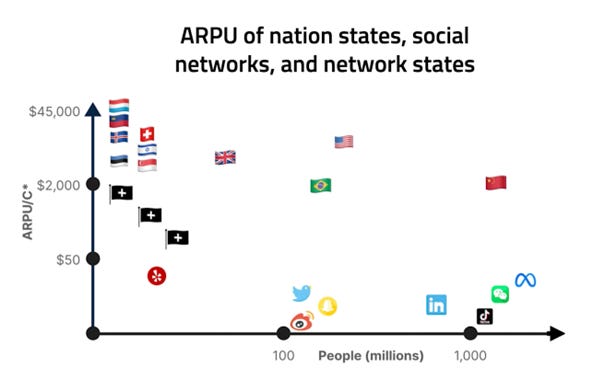
ARPU stands for Average Revenue Per User. In the context of a state, it would refer to the GDP per capita, while for a company, it would be its revenue divided by the number of users. The state-network sits between the black flag, acting as an interface between digital companies and contemporary governments.
Personally, I believe that most criticisms of the state-network are not valid. On the contrary, I see immense potential in aligning the interests of a community sharing the same values without necessarily sharing a defined geographical cluster (at least in the present). Technologies such as blockchain, smart contracts, and DAOs are valuable precisely because of their code. Just as we currently see in the crypto ecosystem, we could imagine a competition of projects leading to better governance overall. While capital was historically tied to geographic areas like cities, this trend is reversing in the era of the Internet, remote work, and freelancing.
The real question is the role that crypto should play in such initiatives. Is it truly necessary to rely on blockchains and everything that comes with them to create and manage virtual communities? Large-scale collaborative projects already exist. For example, Bitcoin did not require a DAO to function; it simply relied on an open forum and a Git repository to host the code. Beyond open-source projects, there are niche communities like video game modding, and numerous examples of Discord communities that have been able to organize real-life events. While elements like having one's own token could foster group cohesion ('asabiyah) and tend towards crypto-tribalism, I doubt that it is truly necessary. If a group of individuals share a set of ideas, there may not be a need for financial incentives to maintain that group cohesion.
Furthermore, if we talk about good governance, it would be relevant to explore new forms of community management at small and large scales. Today, I'm not so certain that political regimes in the West or in developing countries are well-suited for long-term or contemporary societal, spiritual, or material issues. As Rees-Mogg and Davidson argue in the excellent book The Sovereign Individual, the digital era also brings unprecedented sovereignty to citizens. What can a state do if it cannot enforce its taxes, as could be the case with a digital currency like Bitcoin?
Although comparisons with certain states can sometimes make sense, the idea of seeking recognition as a state also seems somewhat twisted. One could already question why states would be willing to collaborate with entities that are not sovereign and, worse yet, could violate the sovereignty of other countries. Furthermore, what would be the benefit of being recognized as a state by other states? Diplomatic recognition and the advantages that come with it? As mentioned above, the state-network aims to be the successor to the nation-state, an improved version for the 21st century. What is the point of negotiating with archaic social technologies that may not withstand the test of time?
So we can think of Patchwork as a new operating system for the world. Of course, it does not have to be installed across the entire world, although it is certainly designed to scale. But, it is easier and much more prudent to start small. Innovations in sovereignty are dangerous.
– Curtis Yarvin, Patchwork: A Political System for the 21st Century, 2008
As mentioned earlier, the state-network is innovative due to its simultaneous emphasis on the digital world and the physical world. However, the principles underlying the state-network are not new. Digital communities have existed since the emergence of the Internet and forums, and this has accelerated with the advent of social networks and early blockchains. City-states have also always had advocates, mainly in libertarian and localist circles. Examples include the Swiss canton system, the political model of Singapore, and the ultra-localism of Liechtenstein. One can think, for example, of Hans-Hermann Hoppe, who envisions an ideal world composed of millions of Liechtensteins.
Hoppe is a fascinating thinker. As a student of Rothbard, he has had a considerable influence within libertarian movements in the United States. Identifying as an Austro-libertarian (a derivative of the Austrian school of economic thought, which emphasizes individualist methodology and individual property rights) and anarcho-capitalist, he has developed several key concepts for right-wing libertarians. These include the ethics of argumentation, an a priori justification of libertarian ethics based on the coherence between values and their application, as well as ostracism, which allows communities to adopt admission norms and thereby exclude certain individuals, in line with the right to free association.
His political contribution is negligible, as is the case for most libertarian groups. However, his intellectual contribution is significant. In particular, his book Democracy: The G/d That Failed has resonated within the libertarian community and is now an essential work, especially within the Bitcoin community. Hoppe criticizes the principle of democracy as a violation of private property, as the majority can enforce rules in this regard if they wish. According to him, it is a form of public government, which he contrasts with private governments as would be the case under other forms of governance, such as monarchy. He uses the analogy of the farm to support his argument: an individual who owns fertile land will do everything to preserve and enhance it in order to pass it on to their children and grandchildren, while someone who rents land will do everything to extract the most value from it and dispose of it as soon as possible. There are clear real-life examples of this, such as the IMF forcing certain countries to open their land and resources to corporations that extract maximum value through monocultures, for example, before abandoning them. This is analogous to the concept of time preference developed by Mises, one of Hoppe's influences. However, he remains critical of monarchy, preferring anarchy as a lesser evil, as a monarch will prioritize the long term, stability, respect for property, and other aspects.
It is important to discuss Hoppe because he was a major influence on a prominent figure in the neoreactionary movement, Curtis Yarvin, also known as Moldbug. With a background in computer science, Yarvin was influenced by the techno-libertarian culture of Silicon Valley in the 1990s during his university years. His interest in libertarianism led him to develop Urbit in 2002, a decentralized network of personal servers. While subsequent readings of Carlyle led him to reject an open conception of libertarianism in favor of a version closer to authoritarianism (which is not fundamentally contradictory), it was Hoppe's book Democracy that was the major turning point for Yarvin towards anti-democracy. Other events in the 2000s, such as the invasion of Iraq and Afghanistan, the election of Barack Obama, and the 2007-2008 financial crisis, also contributed to his shift in thinking. According to him, democratic experimentation has failed, reinforcing his belief that these structures inevitably lead to progressive and short-term ideas.
In 2007, he started his blog, Unqualified Reservations, in which he developed a series of reflections related to his political vision, known on the Internet as the Dark Enlightenment. According to Yarvin, the dominant ruling class in the United States is a distributed network that includes the Democratic Party, universities, mass media, Hollywood, the entertainment industry, corporations, etc., which he calls the Cathedral (think of the connections between Epstein, Weinstein, and the Clintons to understand the underlying idea). Yarvin proposes that it is futile to oppose this order and that it is better to prepare for an exit from this system by developing alternative infrastructures that will dominate the post-progressive era. Examples include Bitcoin, which represents an exit from the contemporary financial system, as well as Urbit with its computational aspects, and others.
In 2008, he published a series of influential articles within the libertarian community titled Patchwork. Patchwork represents part of his political ideal: a hypothetical model of states that emphasizes localized governance and the right to exit as an alternative structure to the Westphalian model of the nation-state. He draws inspiration from the governance models that existed in Central Europe under the Holy Roman Empire, Renaissance Italy, Muslim empires more generally, etc., which experienced significant fragmentation but paradoxically excelled in commerce and techno-cultural development.
The essential inspiration for Patchwork is the observation that the periods in which human civilization has flowered are the periods in which it has been most politically divided. Ancient Greece, medieval Italy, Europe until 1914, China in the Spring and Autumn Period, and so on. Burckhardt once observed that Europe was safe so long as she was not unified, and now that she is we can see exactly what he meant.
– Curtis Yarvin, Patchwork: A Political System for the 21st Century, 2008

The HRE, particularly during the era of kleinstaaterei, appears to be one of the most developed versions of a proto-patchwork. The Empire was composed of approximately 1,800 territories (called landeshoheit in German), exhibiting various aspects of sovereignty, such as the ability to mint their own currency, collect taxes, and have their own judicial system under the authority of an emperor.
Based on this model, Yarvin attempts to propose a post-political model where politics no longer exists. Instead, each city-state is governed authoritatively by an individual or a group of individuals, similar to Singapore, Taiwan, or Hong Kong. However, individuals are free to choose the city-state in which they wish to reside based on their preferences regarding taxation, freedom of expression, religious or racial policies, etc.
His governance model is similar to cameralism, an economic doctrine attributed to Frederick II of Prussia, advocating for a centralized economy for the benefit of the state. One can extrapolate his thinking to the mercantile currents of the European Renaissance. In general, Yarvin desires the establishment of a state that functions like a sovereign corporation, where shareholders elect an absolute CEO. He cites Deng Xiaoping and Lee Kuan Yew as models of leaders. Balaji has openly echoed the idea of a city-state governed like a start-up, as a good governance model, which he has developed in his concept of a network state. There are indeed some similarities between the two, which is not a secret considering the Balaji-Yarvin-Thiel-BAP cluster within the techno-libertarian community.
Overall, Yarvin seems to converge the political advantages of both the left and the right by combining elements of centralization and decentralization simultaneously. In this sense, it resonates with elements of the network state, which also proposes a kind of blockchain market, with some blockchains having varying degrees of public governance depending on the developers. Fundamentally, the success of a project lies in its ability to retain individuals, and as mentioned earlier, this depends on the subjective preferences of those individuals.
Several interpretations of the patchwork concept have already emerged within the accelerationist movement, such as Xenogothic's article titled Patchwork from the Left. It combines Deleuze's concept of nomadology, Landian analysis of capitalism and cybernetics, all within an anti-colonial and radically left framework, offering a perspective that differs significantly from Moldbug's.
I appreciate the idea of Patchwork, just as I appreciate the idea of Meta-Utopia by Zozik or Taleb's fractal localism. These are interesting models that we can see being applied in contemporary East Asian cities like Singapore, Hong Kong, Taipei, and Macao, as well as in Gulf countries, as reflected in my article on Gulf Futurism. It's worth noting that Kuwait, Qatar, Bahrain, and the United Arab Emirates were once a unified country from which some emirates seceded. Fundamentally, there is little difference between the emirate of Sharjah and Qatar: both are city-states surrounded by exploitable land, primarily in the oil extraction industry. Abu Dhabi, Dubai, Sharjah, Umm al-Quwain, Ajman, Fujairah, Ras al-Khaimah, Doha, Kuwait, and Manama already form a string of cities that can to some extent align with the concept of patchwork.
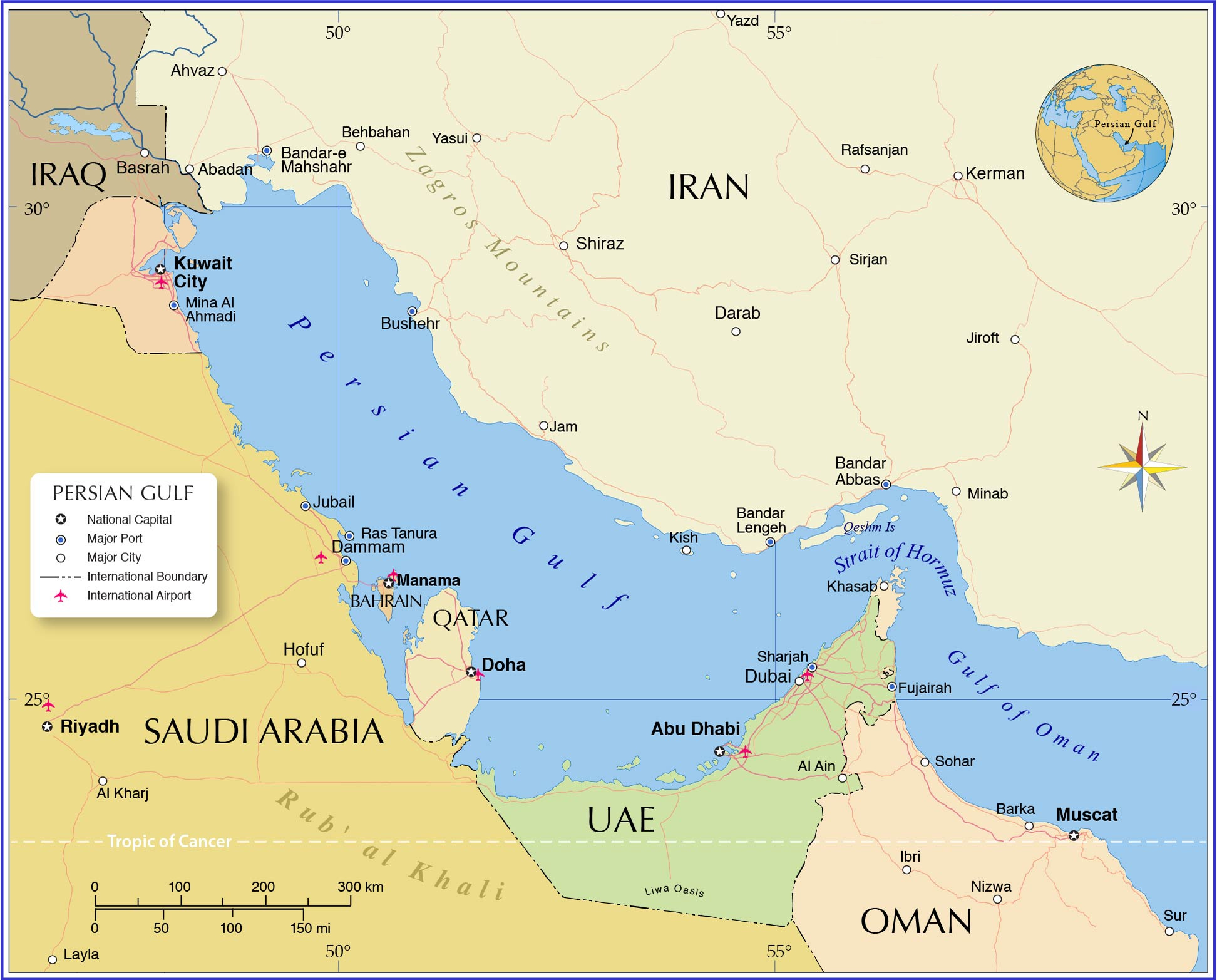
The idea of a patchwork becomes even stronger with MBZ's thalassocratic ambitions in the Indian Ocean. Through the war in Yemen, the Emirates managed to gain control of the island of Socotra, which could potentially become its own emirate in the near future. They also have a military, political, and economic presence in Somalia, specifically in the Somaliland region, as well as in the Seychelles, Comoros, and Maldives. They also support independence movements in South Yemen. Similar to the Omani empire in the past, the Arab Emirates are projecting themselves into the surrounding maritime trade, securing their economic interests by protecting their trade routes and developing one of the least serviced maritime regions. This is also part of the development of trade relations with India, which plays on both sides with Iran. The port of Shahbar, for example, was jointly developed with the Indians.
However, this political structure is part of a larger order, that of macroeconomic stability brought about by the Pax Americana. Gulf countries thrive on international trade, protected by the Americans and their presence in the region. Although this is starting to change with the Iranian threat and its Shiite crescent, as well as the UAE's military industry development and its collaboration with neighboring countries like Israel or Turkey.
This is actually one of the main criticisms of patchwork: the idea that the system would be too utopian or abstract to be applied in real life. What would prevent a city-state from invading another or interfering in the affairs of neighboring cities? We have seen recent examples of this, such as the crisis between Qatar and Saudi Arabia. What if a leader wants to block the exits of their city, as is the case in a country like North Korea? These are questions that have already been addressed by several schools of thought in international relations, including realism. I believe that patchwork, intentionally or unintentionally, falls within a post-liberal thought that takes into account the power of the market and the consequences of regulation as a tool to bring about relative peace. Corporations do not need to physically wage war because wealth today is virtual and abstract, in the form of digital data, technology, and so on. Just as Google does not go around organizing wars in Africa or China does not invade Sri Lanka to secure its trade routes.
To some extent, this is observable. However, as mentioned earlier, it is also because we are in an era of pax americana, which benefits the United States and the countries that have entrusted their defense (and thus, partially, their sovereignty) to it, such as NATO countries and others. Conflicts, mainly through proxy, characteristic of third-generation warfare, flourished during the Cold War: the Korean War, the War of Attrition, the Vietnam War, etc. Not to mention the numerous attempted coups or political assassinations within Southern countries.
Cyberpunk literature has explored the idea of a world dominated by corporations, their wars, industrial espionage, and so on. This may bring to mind Europe during the Renaissance, which was also a period of intense conflict: the Italian Wars, the Thirty Years' War, the Eighty Years' War, the Anglo-Spanish War, the Franco-Spanish War, and more. Conflicts tore Europe apart during that time, and it is evident that such risks could arise in a context of international anarchy without the supervision of a state or a group of states.
In this regard, the role of a monarch, as emphasized by Hoppe, could make sense: a patchwork of independent but not entirely sovereign states willing to pay a defense tax to a ruling family, similar to the ERG I mentioned earlier. Other ideas include the emergence of common defense groups, similar to NATO. However, this would not prevent the existence of legal barriers, such as the establishment of economic standards for international trade. If Apple, Google, and Amazon can argue over payments, why wouldn't it be the case in a patchwork system? One could imagine that these corporations would try to be as technologically sovereign as possible, producing everything locally, including their own phones and operating systems, their own petrochemicals and semiconductors, in order to overcome this issue. However, this goes against the interconnected nature of a patchwork.
Nevertheless, I am fairly confident, even bullish, about the ideas behind patchwork and the network state. I have some thoughts on the subject that could take them to the next level, as in the case of a start-up in uncharted territory. Everything remains to be built for this set of ideas.
As mentioned earlier, Yarvin worked on a project called Urbit before delving into Dark Enlightenment and codifying his patchwork ideology. I described Urbit as a personal server network and decentralized network launched around 2003, and it would be interesting to delve into its case and its relationship with the network state.
Beyond being a simple personal server, Urbit proposes a radical paradigm shift in our relationship with our data and other Internet users. It is a system that allows individuals to own and control their unique digital identity without having to rely on corporate data centers like Alphabet or Amazon. This aligns with some ideas of Web3, but Urbit takes it much further. It is a new operating system and architecture that allows decentralized applications to run peer-to-peer directly from its virtual machine. I have been following this project for a few years, and I find it very interesting.
Balaji has already addressed the relationship between Urbit and the network state during the 2022 Assembly in Miami, highlighting the role of decentralized protocols, specifically Urbit, in the future of states. According to him, Urbit can have a significant influence in creating and managing digital communities by providing the necessary infrastructure for them to exist and function effectively. Urbit could pave the way for the creation of decentralized social networks, cryptocurrencies, and other applications necessary for a self-governed community.
Beyond being a decentralized Discord, one can imagine a return to the early days of the Internet, with an emphasis on peer-to-peer protocols, local computation instead of the cloud, pseudonymity, and more. The strength of Urbit, for now, goes beyond its technical product and lies within its highly passionate and ideologically aligned community. It resembles the Bitcoin community between 2011 and 2013 or the Ethereum community between 2014 and 2016.
The resilience of contemporary nation-states is often taken for granted. For younger generations, the United Nations seems like an idea that has always existed. Even during the height of the Cold War, the USSR failed to find an alternative. North Korea agrees to be a member, despite international sanctions and lack of direct recognition. We feel trapped within our current governance systems because we don't open our eyes wide enough. Beyond more conventional alternative governance models, new technologies have opened the door to a range of tools that enable communities to self-govern, sometimes outside the spectrum of the state. Encryption, the Internet, Bitcoin, DAOs, and others are examples among many—and the heated debate between proof-of-work and proof-of-stake within the crypto space is one of the most prominent examples.
The Internet, in particular, enables new use cases that would have been difficult before. Individual empowerment is significantly strengthened, while the role of governments is diminished. Tax evasion becomes more challenging to control with Bitcoin, and the content of letters or packages becomes harder to monitor with PGP encryption. However, this assumes an open Internet, which may not be the case in the near future. The splinternet, the fragmentation of the Internet by corporations or governments, is an ongoing event that is likely to accelerate. The European Union aims to acquire its own DNS resolver to limit access to certain websites—torrent sites today, and potentially Chinese sites that do not comply with European data usage standards tomorrow.
Several models appear to be in conflict. Balaji enumerates three: the NYT model, representing the contemporary American establishment, woke capitalism, democracy by drone, and cancel culture; the CCP model, representing China, state capitalism, collectivization, centralization, and mass surveillance; and the BTC model, representing anti-corporate capitalism, decentralization, and individualism. Will one model dominate over the others? How will these models evolve?
The network state seems to align with this third option, but it would be arbitrary to confine such a metaconcept to a specific category. Dubai, a favored location for the technocapitalist community, seems to lean towards a combination of capitalism and mass surveillance, openness to crypto but an absence of freedom of expression—and that's just fine. In a model like the network state or Patchwork, each individual could join the city or network union that best aligns with their individual expectations.
We should not be afraid to contemplate alternative governance models that can address social, environmental, religious, economic, and other problems, regardless of their scale.